关键源码
- Pi:
agent-loop.ts、agent.ts - Codex:
session/turn.rs、tools/router.rs、tools/registry.rs - DeepSeek Harness:
agent-loop/src/agent.ts、core/tools/src/index.ts - Claude Code:
query.ts:L219、toolExecution.ts:L599
结论先行
四者循环都实现“采样 → 工具 → 把结果交还模型”,但控制权落点不同。Pi 把最小双层循环暴露给扩展;Codex 用 submission/task/step 三层把外部操作与当前 turn 解耦;DSH 把 loop 缩到事件提交和 waterfall,把行为移至 plugins;Claude Code 在单一 async-generator 状态机中整合产品能力。工具侧对应四种风格:Pi 的简洁 batch executor、Codex 的 router/registry/orchestrator 分层、DSH 的 native/PTC 统一 runtime、Claude Code 的验证/hooks/permissions 管线。
核心概念
| 概念 | 问题 |
|---|---|
| Turn vs step | 一次用户输入中,模型因工具结果继续采样几次? |
| Steering | 工具执行中或两次采样间的新输入如何进入? |
| Exact context | 并发期间一次 tool/sample 读取的是启动时还是最新状态? |
| Tool normalization | 不同 wire-format call 在哪一层转为统一 invocation? |
| Ordering | 并发完成顺序与写回模型的顺序是否相同? |
| Lifecycle hooks | 参数修改、阻断、输出重写与遥测在哪一层发生? |
| Failure encoding | 异常抛出、tool-result error、durable event 各自如何影响 loop? |
1. 四种控制流

Pi:外层 follow-up,内层 steering/tool
Pi 在注入 prompt 后发出 agent/turn/message events,内层消费 tool calls 和 steering,外层在一次自然 turn 结束后消费 follow-up。agent-loop.ts:L96-L143 agent-loop.ts:L156-L272 Agent 明确维护两个队列,所以“打断当前工作”和“本轮后追加任务”是不同语义。agent.ts:L125-L159 agent.ts:L282-L305
Codex:Submission → Task → sampling step
Codex 的 submission loop 先路由 turn、approval、compact、rollback、MCP reload 等操作;普通 turn 才创建 RegularTask,后者再进入 run_turn。handlers.rs:L530-L715 regular.rs:L30-L95 每个 sampling step 捕获 exact StepContext,采样后综合 tool follow-up、pending input 和 token 状态决定下一步。turn.rs:L296-L500 这是四者中最明确区分“外部 session 操作”和“当前采样状态”的实现。
DSH:Durable events 包围薄 loop
DSH 每步 claim inbox、组装上下文并运行 pre-step waterfall;turn/step/user/stop 先落 event log,LLM raw chunks 与 assembled message 也持久化,然后才执行工具。agent.ts:L232-L336 agent.ts:L339-L435 Loop 算法本身简单,关键不变量是任何 model-visible surface 都可由 durable events 重建。
Claude Code:产品能力进入一个 async-generator 状态机
queryLoop 用可变 State 和 while(true) 推进,每次调用前先执行 microcompact/context collapse/autocompact。query.ts:L219-L321 query.ts:L412-L468 工具后再吸收 memory/skill/notification attachments、刷新 MCP 和构造下一轮 State。query.ts:L1659-L1728 集中 loop 易于共享给 REPL/SDK/subagent,但 feature-gated 路径也更密集。
2. 模型调用边界
| Agent | 请求对象的生命周期 | Provider/transport 关键语义 |
|---|---|---|
| Pi | 每次调用在 transformContext → convertToLlm → streamFn 边界动态取 model/auth。agent-loop.ts:L275-L310 | Provider 同时承载 model catalog、auth、stream;API 模块懒加载,错误进入流。models.ts:L151-L223 |
| Codex | ModelClient 属于 session,ModelClientSession 属于 turn;step 使用 exact context。client.rs:L281-L329 | Responses-only;WS 失败使当前 session 永久降级 HTTP,auth 可刷新重试。client.rs:L1652-L1703 |
| DSH | Prepared call 捕获 adapter generation/config,只 dispatch 一次。llm/index.ts:L157-L191 | Adapter 注册 effect-scoped 且 atomic replace;credential 在请求时解析。llm/index.ts:L372-L454 |
| Claude Code | query 每轮把完整 messages/system/tools/model/fallback/task budget 交 API。query.ts:L650-L705 | 自管 retry/raw stream,可转非流式,但特别防范 streaming tool 重复执行。claude.ts:L2464-L2562 |
Pi 的优势是 provider 切换和认证刷新自然;Codex 对 turn state 与 transport 降级定义最细;DSH 对热替换 generation 一致性最强;Claude Code 为 Anthropic API 的流式、prompt caching 和 fallback 做最多产品化特化。这里的“优势”指代码边界匹配度,不代表模型效果。
3. 工具调用的阶段对照
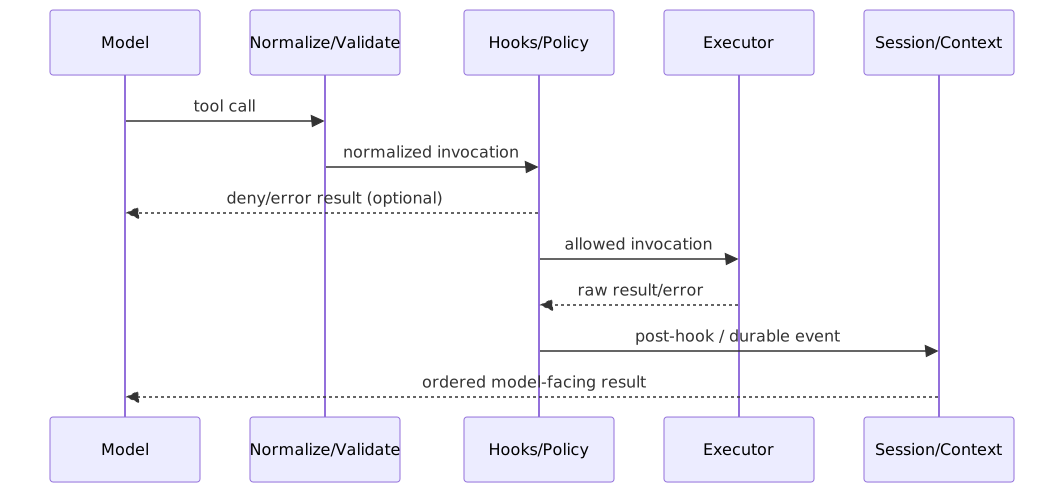
- Pi:先拒绝 truncated call,再做 schema +
beforeToolCall;工具返回事件可按完成顺序出现,但 model messages 按原调用顺序。agent-loop.ts:L372-L404agent-loop.ts:L487-L551 - Codex:Router 先归一化 Responses function/custom/tool-search call,Registry 再运行 Pre/PostToolUse,可改参数与 model-facing output。
router.rs:L245-L382registry.rs:L582-L755 - DSH:
ToolRuntime把 pre/execute/post、schema、render、timeout 与 presentation 统一;native 与 PTC 子调用共享此路径。tools/index.ts:L137-L287ptc.ts:L286-L360 - Claude Code:Zod + custom validation 后运行 hook,权限决定在 hook 之后;允许才
tool.call(),再跑 post hook 和 MCP 专用 output 处理。toolExecution.ts:L599-L687toolExecution.ts:L795-L1046toolExecution.ts:L1171-L1515
4. 并发与结果顺序
| Agent | 并发单位 | 冲突/顺序策略 |
|---|---|---|
| Pi | 同一模型消息中的 tool-call batch | 默认并行;任一 sequential 工具令整批串行;结果写回按 call order。agent-loop.ts:L406-L551 |
| Codex | In-flight tool futures | Parallel-safe 工具拿共享读锁,非并行工具拿独占写锁;取消 abort future。parallel.rs:L147-L209 |
| DSH | ToolRuntime scheduler / PTC 子调用 | Native 与 PTC 使用同一顺序和并发语义;具体工具通过 runtime 注册约束。ptc.ts:L286-L360 |
| Claude Code | 普通 runTools 或 StreamingToolExecutor | 2.1.88 可确认分流与结果归并,完整 streaming 冲突算法仍待追踪。query.ts:L1360-L1409 |
Pi 的 batch-level sequential 最容易预测,但一个 sequential 工具会保守串行整个批次。Codex 的 RW gate 能让多个 read-like invocation 并行又阻止 write-like 重叠。DSH 把并发抽象跨 native/PTC 保持一致。Claude Code 的 streaming executor 有更早启动工具的空间,也带来 partial argument、重复执行和取消复杂度。
5. 错误、取消与下一步
Pi 把 provider import 失败编码为流事件,并把不允许的 tool call 作为可给模型解释的结果;overflow compact-and-retry 最多一次,边界简单。lazy.ts:L41-L98 agent-session.ts:L2152-L2195
Codex 把 approval response、取消、compact 和 shutdown 都作为 submission;tool failure 与 sandbox denial 有不同状态转换,只有后者进入 escalation path。handlers.rs:L530-L715 orchestrator.rs:L305-L438
DSH 在 append 前验证事件不变量,commit 后 observer 失败不回滚事实;overflow 后只有 surface 实际前进才重试。session/index.ts:L567-L646 compaction-basic:L126-L223 这是最强的 replay-oriented failure model,但调试时必须理解 projection 与 effect teardown。
Claude Code 把拒绝编码为 is_error tool-result,让模型看到并调整;subagent/REPL/SDK 又都在 finally/control layer 清理专属资源。toolExecution.ts:L916-L1046 runAgent.ts:L819-L834
6. 机制选择的实际含义
- 如果要嵌入自己的模型/provider 与工具体验,Pi 最少约束,但宿主需自行补安全和调度。
- 如果要证明一次命令从模型到 OS 的完整状态转换,Codex 的 router/registry/orchestrator 层最直接。
- 如果要重放同一请求和组合、热替换 provider/tool,DSH 的 generation + event surface 最贴题。
- 如果要在一个成熟交互 loop 中复用 REPL/headless/subagent,Claude Code 的 query generator 边界清晰,但最新版实现不可见。
这些是由源码边界推导的工程适配,不是完成率比较。
系列导航
活跃开发方向
- Pi durable operations 与新 session lanes。
- Codex exact-step context、tool-search 与 multi-agent futures。
- DSH PTC runtimes、adapter generation replacement。
- Claude Code streaming tool execution 与非流式 fallback 去重。
待调查问题
- [待调查] 用同一 mock LLM stream 对四者注入 malformed/truncated/duplicate tool calls,验证实际顺序和重试。
- [待调查] 并发读写同一文件时,各 runtime 的声明、检测与真实冲突行为。
- [待调查] 用户 steering 恰在 tool approval、compaction 或 provider reconnect 时到达的线性化点。
- [待调查] Claude Code
StreamingToolExecutor的完整依赖图、取消和幂等协议。 - [待调查] DSH committed event observer 失败后的 UI/ACP projection 恢复时延。